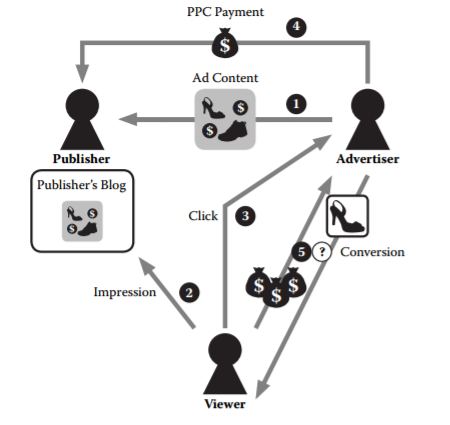
Any advertising transaction has three primary parties: the advertiser, the publisher, and the viewer. The advertiser is a company that produces content it would like to display to potential customers. This content is an advertisement for a specific product or service that is likely to generate revenue for the advertiser. The publisher is a creative outlet that produces content that will draw visitors to its medium. These visitors view the ad and, ideally, purchase the
advertised product or service. The advertiser pays a fee for a specific
number of “impressions,” which is the estimated number of times a viewer will see the ad. This model is essentially the same across all forms of media, including print, radio, and television.
PPC uses the same general model as other forms of advertising, but
introduces an interactive component. While an especially impressive
car commercial may entice a television viewer into purchasing a new sedan, it is difficult for the advertiser to link a particular ad directly to that sale. The Internet makes this possible because when a viewer finds an ad compelling, he or she can click it to get more informa-
tion or purchase the product. If, and only if, the viewer clicks on the ad, the advertiser will pay the publisher a fee. The direct correlation between the viewer’s action and the cost to the advertiser is the primary distinction between PPC and impression-based advertising.
The ultimate goal for the advertiser is to convert ad clicks to actions that generate more revenue than the advertising campaign costs. When
the viewer takes the desired action, be it signing up for a newsletter or purchasing a new car, a conversion has occurred. This conversion
completes the PPC business model. This picture shows how money flows in this business model.
 RED ZONE