Hello Hackers, This article is all about is phishing. So Very long But you know 1% ➡️ 100% about phishing and How to safe from this type of attacks and all information. With Example!!
Most instances of SMS phishing (smishing) target banks or financial institutions by sending a phone number that the victim calls after receiving the message, resulting in a vishing attack.
In the past, attackers used vishing against random targets and were
successful at evading defensive filters. For instance, actors have used
SMS gateways that allow users to send e-mails instead of spending money per SMS message. In this way, actors send messages to all possible SMS recipients for a gateway. As an example, the SMS gateway receives e-mail messages sent to the phone number 111-222-3333 atthe e-mail addres-1112223333@mobile.gateway.example.com. SMS gateway providers have responded to abuse by rejecting excessive numbers of messages or fraudulent messages. This is dependent upon the cooperation of the Internet service providers (ISPs) themselves, rather than defensive tools on a mobile device. Uncooperative or unwilling ISPs could cause this type of filtering to fail.
There are several common themes in smishing messages. The following examples all include phone numbers for victims to call. The messages may originate from either a phone number or an e-mail address, both of which an attacker can spoof.
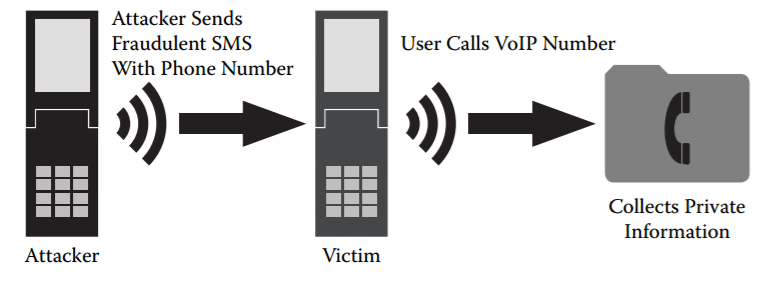
Ex:- ApplicationCenter/This is an automated message from Lafayette F.C.U..Your ATM card has been suspended. To reactivate call urgent at 1-567-248-8594
From: Jennifer [@]fortheloveofmarketing.com
Your Treasury Department FCU account is expired, for renewal please
call us toll free 818.462.5049
jAPANESS MOTORS AUTO AFRIC, You have won a Brand new Toyota landcruiser VX, in our annual draw. Call Mr. Peter Aganyanya through this No. +254727925287
Announcement from PETRONAS MLSY. CONGRATULATIONS your phone number has won a prize of RM 11000. (About US$3,200) Please contact the following number at 0062858853982xx tomorrow
morning at 8.00am. Thank you
Official Microsoft ANNOUNCEMENT: Congratulations! Your mobile phone has won US$ 10 Million prize money. To claim your money,call this number XXXXXXXX tomorrow at 8 AM. Thank you
Many of these systems use voicemail systems to steal user information, including bank account information. There have been attacks where vishers answer the phones themselves F-Secure documented one such incident regarding the 0062858853982xx phone number
with a transcript and audio files.30 Similar to traditional phishing
attacks, smishing and vishing attacks frequently use fake rewards and
fake account alerts.
In January 2008, the Facebook application Secret Crush began phishing users by requesting their mobile phone number through the social-networking website. Subsequently, it would send them
messages from a premium SMS service that costs $6.60 per message according to one user afflicted by the scam. Users that reply to the premium rate number (19944989) would receive the bill to their mobile phone.
Whocallsme.com is a resource where users frequently report issues related to phone numbers. Users often report SMS scams, banking fraud, and other incidents to this website based upon the originating phone number. A few examples include Dear Credit union customer, we regret to inform you that we had to lock your bank account access. Call (647) 827-2796 to restore your bank account.
!!Urgent! Your number has been selected for a $5000 prize guaranteed!
To claim your prize call +423697497459
Organizations should monitor their own SMS number services via sites like whocallsme.com to see if users are suspicious of their services. Such suspicions could indicate mistrust in the legitimate service or attackers who are spoofing the number of the affected organization to improve their chances of gaining trust.
Smishing and vishing are serious problems. Antiphishing products
are designed to filter e-mails, but mobile phishing is more difficult
to filter for both users and automatic products. SMS messages con-
tain much less tracking information; therefore, recipients will not be
able to determine from where they originate. Mobile phone brows-
ers and SMS programs also lack integrated phishing defenses built
into today’s e-mail clients and browsers. Smishers also often spoof the source address and use a large number of different phone numbers to perform vishing. Mobile browsers also make it difficult to determine
the legitimacy of a URL. The small form factor and limited display are incapable of displaying full URLs, and it can take as many as ten clicks to access the security information of a site. Most mobile browsers lack support for protections normally available on desktop systems such as URL filtering, phishing toolbars, and extended validation (EV) SSL certificates. Based upon these concerns, it seemslikely that users of mobile devices have an increased risk of falling victim to a phishing attack when they surf with mobile browsers or receive fraudulent SMS messages.
 RED ZONE